Sunday, November 1, 2015


Scrap Reservation in Higher Education- against Society- Supreme Court
In national interest, scrap quota in higher education institutions: Supreme Court
Emphasising what the apex court held 27 years ago, the bench said it is now “inclined” to convey the same message to the central and state governments over reservation in institutions of higher education.
http://indianexpress.com/article/india/india-news-india/in-national-interest-scrap-quota-in-higher-education-institutions-supreme-court/
Written by Utkarsh Anand | New Delhi | Updated: October 28, 2015 8:20 pm
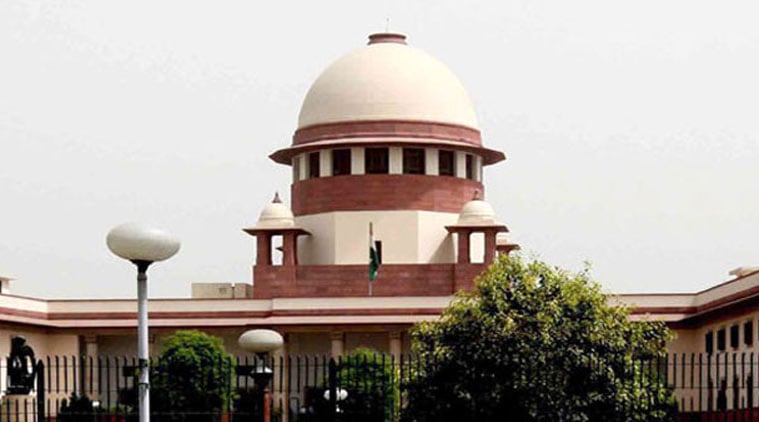
A bench noted that despite several reminders to central and state governments to make merit the primary criteria for admissions into super-specialty courses, the ground reality remains that reservation often holds sway over merit.
Regretting that some “privilege remains unchanged” even after 68 years of independence, the Supreme Court held Tuesday that national interest requires doing away with all forms of reservation in institutions of higher education, and urged the Centre to take effective steps “objectively”.
A bench of Justices Dipak Misra and P C Pant noted that despite several reminders to the central and state governments to make merit the primary criteria for admissions into super-specialty courses, the ground reality remains that reservation often holds sway over merit.
“The fond hope has remained in the sphere of hope… The said privilege remains unchanged, as if (it is) to compete with eternity,” the bench remarked, adding that it concurs completely with what the Supreme Court had ruled in 1988 in two judgments.
In these two cases, while dealing with the issue of reservation in super-specialty courses in medical institutions, the top court had said “there should really be no reservation” since it is in the general interest of the country for improving the standard of higher education, and thereby improving the quality of available medical services to the people of India.
“We hope and trust that the Government of India and the state governments shall seriously consider this aspect of the matter without delay and appropriate guidelines shall be evolved…” these judgments stated.
Emphasising what the apex court held 27 years ago, the bench said it is now “inclined” to convey the same message to the central and state governments over reservation in institutions of higher education.
“Therefore, we echo the same feeling and reiterate the aspirations of others so that authorities can objectively assess and approach the situation so that the national interest can become paramount,” the court said.
It also referred to a body of judgments, asking government authorities to abstain from relaxing the eligibility criteria basing it on various kinds of reservation since it would defeat the very object of imparting the best possible training to selected meritorious candidates.
The bench made these observations as it delivered its judgment on a batch of petitions, which had challenged an eligibility criteria for admissions into certain super-specialty medical courses in Andhra Pradesh, Telangana and Tamil Nadu. They allowed only those having domicile in the three states to appear for the examination, thereby making the seats reserved only for such candidates, based on residence.
The bench said it cannot interfere with the admission process in Andhra Pradesh and Telangana since a Presidential Order has created an exception and the constitutionality of this Order had not been challenged. But it agreed to examine on November 4 whether Tamil Nadu could do the same and allow this form of reservation in a post-graduate programme.
Even as it expressed its inability to adjudicate the constitutionality of the special privilege granted to Andhra Pradesh and Telangana under Article 371-D of the Constitution and the Presidential Order, the bench observed that such privileges ought to be reconsidered by the governments and steps be taken.
- See more at: http://indianexpress.com/article/india/india-news-india/in-national-interest-scrap-quota-in-higher-education-institutions-supreme-court/#sthash.7ZPoAJeI.dpuf


American Biblical Racism. Police use Extreme Violence against Sureshbhai Patel
Patel victim of ‘extreme violence’
http://www.deccanchronicle.com/151031/world-americas/article/patel-victim-%E2%80%98extreme-violence%E2%80%99


Washington: A former American police officer used an “extremely violent technique” against Sureshbhai Patel that left him partially paralysed early this year, a key police official has told a US federal jury on Friday.
Testifying before a federal grand jury in Huntsville, Kenny Sanders, a sheriff’s department captain who oversees the state’s police training curriculum, said the conduct of former police officer Eric Parker “was not consistent with prevailing police standards” against Patel, who is now recovering from the assault.
While on a walk, Parker stopped Patel, who did not knew English. When Patel did not respond, Parker hit him so hard on the ground that he was left partially paralysed.
The retrial of Parker, charged with violating Patel's civil rights following an encounter in a Madison neighbourhood off County Line Road on February 6, began this week.
The jury has 14 members, of which 11 are women and three men. Patel, who was visiting his son in Alabama to meet his newly born grandson, was slammed to ground and left paralysed in 101 seconds after encountering the police despite him pleading as many as five times that he knows no English, prosecutors said.
US policeman who attacked Indian grandfather arrested; FBI to probe incident
IS Demolishes 2000 Year old temple with Human Bombs
ISIS Demolishes Second 2000-Year-Old Temple in Ancient Syrian City

One week after detonating the 2,000-year-old temple of Baalshamin, ISIS has destroyed a second ancient temple in the Syrian city of Palmyra. Tuesday morning, the UN released satellite photos confirming the demolition of the Temple of Bel, which dates back to 32 B.C.

“We can confirm destruction of the main building of the Temple of Bel as well as a row of columns in its immediate vicinity,” UNOSAT Manager Einar Bjorgo said, according to the Guardian.

The photo above was taken on August 27. It shows, according to the UN, the temple standing, surrounded by a row of columns. The photo below was taken four days later.

Earlier this week, Syria’s antiquities chief Maamoun Abdulkarim called the temple, which was visited by more than 150,000 people a year before the start of the Syrian civil war in 2011, “the most important temple in Syria and one of the most important in the whole Middle East.”
“I feel very sad and I am very pessimistic... for the future of Palmyra,” he toldthe BBC.
Before destroying the Temple of Bel and the Temple of Baalshamin, ISIS fighters beheaded Khaled al-Asaad, an 82-year-old Syrian scholar. Al-Assad, who spent more than 50 years as the head of antiquities in Palmyra, was reportedly killed because he refused to reveal the location of hidden artifacts in the region.

Bangladesh Blogger -Publishers Killed. Freedom of Expression suppressed by Killing.
Secular publisher hacked to death in latest Bangladesh attacks
Faisal Abedin Deepan killed on same day as attacks on publisher Ahmed Rahim Tutul and two writers
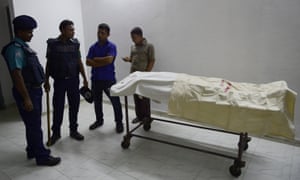

Police stand with the body of Faisal Arefin Deepan, a publisher of secular books. Photograph: Munir Uz Zaman/AFP/Getty Images
Associated Press
Saturday 31 October 2015 15.33 GMT Last modified on Saturday 31 October 2015 18.53 GMT
Share on Pinterest Share on LinkedIn Share on Google+
Shares
2,940
Save for later
A publisher of secular books has been hacked to death in the Bangladeshi capital, police have said. In a separate attack in Dhaka, police said two other writers and a publisher were stabbed and shot at a publishing house.
Fears of Islamist violence have been growing in Bangladesh after at least four atheist bloggers were murdered in the country this year. The attacks have been linked by police to domestic Islamist extremists, while Islamic State has claimed responsibility for three other attacks.
The body of Faisal Abedin Deepan, of the Jagriti Prokashoni publishing house, was found inside his office, said senior police officer Shibly Noman. The publisher had filed a complaint with police afterdeath threats on Facebook, friends said.
Earlier in the day, publisher Ahmed Rahim Tutul was attacked in the office of the Shudhdhoswar publishing house and seriously wounded. Two writers were also wounded in that attack. All three of the victims were hospitalised, and Tutul was in critical condition, police said.
Both Deepan and Tutal had published books by Bangladeshi-American writer and blogger Avijit Roy, who was hacked to death in February. He was one of the four secular bloggers killed in Bangladesh this year.
A local Islamist group, Ansarullah Bangla Team, had claimed responsibility for the killings and recently threatened to kill more bloggers. At least 15 members of Ansar Bangla, including a British citizen, have been arrested since August, when blogger Niloy Chatterjee was killed by a group of attackers armed with machetes.
No one has yet claimed responsibility for Saturday’s attacks.
Robert Gibson, the British high commissioner to Bangladesh, condemned Saturday’s attacks. “Violence is never the answer or acceptable in any circumstances,” he tweeted.
Bangladesh has been rocked by a series of attacks this year claimed by Islamic extremists, including the blogger murders and, more recently, the killing of two foreigners: an Italian aid volunteer and a Japanese agricultural worker. A bomb attack on 24 October in Dhaka aimed at Shia Muslims killed a teenager and injured more than 100 other people.
Isis claimed responsibility for the attacks on the two foreigners and the bombing, but Bangladesh’s government has denied the extremist Sunni militant group has any presence in the country.
The government has instead blamed domestic Islamist militants and political parties for orchestrating the violence in a bid to destabilise the nation.
Avijit Roy’s books included Caravan of Darkness Walking With Light in Hand (2005), In Search of Life and Intelligence in the Universe (2007), The Virus of Faith (2008), Homosexuality: A Scientific and Socio-psychological Investigation (2010) and The Philosophy of Disbelief (2011).
American atheist blogger hacked to death in Bangladesh - Avijit Roy
Third Bangladeshi blogger killed in machete attack - Ananta Bijoy Das

Bangladesh Bloggers Avijit Roy and Ananta Bijoy DasMurder, Pakistani Bloggers Not Worried


Subscribe to:
Posts (Atom)