JESUS- 12 Apostles could have been Zealots who fought Romans expecting end of the world in their Life time and as per Biblical Scholars were never divine.
I talked to a Yale professor, who is an archaeologist, and was director of the American School of Oriental Research in Jerusalem. He told me that it would be very improbable that a name with three words, and one so complete, could refer to any other than St. Peter.

But what makes the possibility of error more remote is that the remains were found in a Christian burial ground, and more yet, of the first century, the very time in which Peter lived. In fact, I have a letter from a noted scientist stating that he can tell by the writing that it was written just before the destruction of Jerusalem by Titus in 70 A.D.
I talked to priest Milik, the co-writer of this Italian book, in the presence of my friend, a Christian Arab, Mr. S. J. Mattar, who now is the warden of the Garden Tomb, where Jesus was buried and rose again. This priest, Milik, admitted that he knew that the bones of St. Peter are not in Rome. I was very much surprised that he would admit that, so to confirm his admittance, I said, to which he also agreed, "There is a hundred times more evidence that Peter was buried in Jerusalem than in Rome." This was something of an understatement, for he knew as I know that there is absolutely no evidence at all that Peter was buried in Rome. I have spoken on the subject to many Franciscan priests who either were or had been in Jerusalem, and they all agree that the tomb and remains of St. Peter are in Jerusalem. There was just one exception which is interesting and which only proves the point. The Franciscan priest, Augusto Spykerman, who was in charge of the semi-private museum inside the walls of old Jerusalem, by the site of the Franciscan Church of the Flagellation, was that exception. When I asked to see the museum, he showed it to the three of us, Mr. Mattar, who in addition to being warden of the Tomb of Christ, had been the manager of an English bank in Jerusalem, a. professional photographer and myself. But he told us nothing of the discovery. I knew that the evidence of Peter’s burial was there, for priests had told me that relics from the Christian burial ground were preserved within this museum. People who lived in Jerusalem all their lives and official guides who are supposed to know every inch of the city, however, knew nothing of this [pg 5] discovery, so well was it withheld from the public. I had asked an elderly official guide where the tomb of St. Peter was. He responded in a very profound and majestic tone of voice, "The Tomb of St. Peter has never been found in Jerusalem." "Oh," I said, "but I have seen the burial place of Peter with my own eyes." He turned on me with a fierceness that is so common among Arabs. "What," he replied, "you a foreigner mean to tell me that you know where the tomb of St. Peter is when I have been an official guide for thirty-five years and know every inch of ground in Jerusalem?" I was afraid that he would jump at my throat. I managed to calm him as I said, "But sir, here are the pictures and you can see the ossuary, among others, with Peter’s name in Aramaic. You can also see this for yourself on the Mount of Olives on the Franciscan Convent site called, "Dominus Flevit". When I finished he slowly turned away in stunned amazement. A person who has seen this Christian burial ground and knows the circumstances surrounding the case could never doubt that this truly is the burial place of St. Peter and of other Christians. I, too, walked around in a dreamy amazement for about a week for I could hardly believe what I had seen and heard. Since the circulation of this article, they do not allow anyone to see this burial place.
Before things had gone very far, I had been quite discouraged for I could get no information from the many priests with whom I had talked. However, I continued questioning priests wherever I would find them. Finally one priest dropped some information. With that knowledge I approached another priest who warily asked me where I had acquired that information. I told him that a priest had told me. Then he admitted the point and dropped a little more information. It went on like that for some time until I got the whole picture, and I was finally directed to where I could see the evidence for myself. To get the story, it made me feel as though I had a bull by the tail and were trying to pull him through a key hole. But when I had gathered all the facts in the case, the priests could not deny the discovery of the tomb, but even confirmed it, though reluctantly. In fact, I have the statement from a Spanish priest on the Mount of Olives on a tape recorder, to that effect.
But here we were talking to this Franciscan priest in charge of the museum, asking him questions which he tried to evade but could not because of the information I had already gathered from the many priests with whom I had spoken. Finally after the pictures of the evidence were taken, which was nothing short of a miracle that he allowed us to do so, I complimented him on the marvelous discovery of the tomb of St. Peter in Jerusalem that the Franciscans had made. He was clearly nervous as he said, "Oh no, the tomb of St. Peter is in Rome." But as he said that, his voice faltered, a fact which even my [pg. 6] friend, Mr. Mattar, had noticed. Then I looked him squarely in the eyes and firmly said, "No, the tomb of St. Peter is in Jerusalem." He looked at me like a guilty school boy and held his peace. He was, no doubt, placed there to hide the facts, but his actions and words, spoke more convincingly about the discovery than those priests who finally admitted the truth.
I also spoke to a Franciscan priest in authority at the priest’s printing plant within the walls of old Jerusalem, where their book on the subject was printed. He also admitted that the tomb of St. Peter is in Jerusalem. Then when I visited the Church of the Nativity in Bethlehem, I encountered a Franciscan monk. After telling him what I thought of the wonderful discovery the Franciscans had made, I asked him plainly, "Do you folks really believe that those are the remains of St. Peter?" He responded, "Yes we do, we have no choice in the matter. The clear evidence is there." I did not doubt the evidence, but what surprised me was that these priests and monks believed that which was against their own religion and on top of that, to admit it to others was something out of this world. Usually a Catholic, either because he is brainwashed or stubbornly doesn’t want to see anything only that which he has been taught, will not allow himself to believe anything against his religion, much less to admit it to others. But there is a growing, healthy attitude among many Catholics, to "prove all things, hold fast to that which is good" as the Master admonished us all.
Then I asked, "Does Father Bagatti (co-writer of the book in Italian on the subject, and archaeologist) really believe that those are the bones of St. Peter?"
"Yes, he does," was the reply.
Then I asked, "But what does the Pope think of all this?"
That was a thousand dollar question and he gave me a million dollar answer.
"Well," he confidentially answered in a hushed voice, "Father Bagatti told me personally that three years ago he went to the Pope (Pius XII) in Rome and showed him the evidence and the Pope said to him, ‘Well, we will have to make some changes, but for the time being, keep this thing quiet’." In awe I asked also in a subdued voice, "So the Pope really believes that those are the bones of St. Peter?"
"Yes," was his answer. "The documentary evidence is there, he could not help but believe."
I visited various renowned archaeologists on the subject. Dr. Albright, of the John Hopkins University in Baltimore, told me that he personally knew priest Bagatti and that he was a very competent archaeologist. I also spoke with Dr. Nelson Gluek, archaeologist and [pg. 7] president of the Hebrew Union College in Cincinnati, Ohio. I showed him the pictures found in this article, but being with him for only a few minutes I therefore could not show him the wealth of material that you have before you in this article. However, he quickly recognized the Aramaic words to be "Simon Bar Jona". (Aramaic is very similar to Hebrew). I asked him if he would write a statement to that effect. He said to do so would cast a reflection on the competency of the priest J. T. Milik, who he knew to be a very able scientist. But he said that he would write a note. I quote, "I regard Father J. T. Milik as a first class scholar in the Semitic field." He added, "I do not consider that names on ossuaries are conclusive evidence that they are those of the Apostles."
Nelson Glueck
I quote this letter of Dr. Glueck because it shows that priest Milik is a competent archaeologist. As I have mentioned, I was only able to be with him for a few minutes and was not able to show him but a very small part of the evidence. Anyone, including myself, would readily agree with Dr. Glueck that if only the name Simon Bar Jona on the ossuary was all the evidence that was available it would not be conclusive evidence that it was of the Apostle Peter, though it would certainly be a strong indication.
The story of the cave and the ossuaries and the regular cemetery just outside of the Convent site is this: It was a Roman custom that when a person had died and after about ten years when the body had decomposed, the grave would be opened. The bones would be placed in a small ossuary with the name of the person carefully written on the outside front. These ossuaries would then be placed in a cave as in the case of this Christian burial ground and thus making room for others. But this cave or burial place where the ossuaries were found and which was created and brought about through the natural and disinterested sequence of events, without any reason to change facts or circumstances, was a greater testimony than if there were a witness recorded, stating that Peter was buried there. And yet, even that is unmistakenly recorded in the three words in Aramaic of the ossuary, Simon Bar Jona.
Herein, lies the greatest proof that Peter never was a Pope, and never was in Rome, for if he had been, it would have certainly been proclaimed in the New Testament. History, likewise, would not have been silent on the subject, as they were not silent in the case of the Apostle Paul. Even the Catholic history would have claimed the above as a fact and not as fickle tradition. To omit Peter as being Pope and in [pg. 8]
 [pg. 9]
 [pg. 10]

[pg. 11]
[pg. 12]
Rome (and the Papacy) would be like omitting the Law of Moses or the Prophets or the Acts of the Apostles from the Bible.
Dr. Glueck, being Jewish, and having been to Jerusalem, no doubt, is fully aware of the fact that for centuries the Catholic Church bought up what were thought to be holy sites, some of which did not stand up to Biblical description. For instance, the priests say that the tomb of Jesus is within the walls of the old Jerusalem, in a hole in the ground; whereas, the Bible says that the tomb where Jesus was laid was hewn out of rock and a stone was rolled in front and not on top of it. The Garden Tomb at the foot of Golgotha, outside the walls of old Jerusalem, meets the Biblical description perfectly. In fact, all those who were hated by the Jewish leaders, as Jesus was, could never have been allowed to be buried within the gates of the Holy City. The tomb where Jesus lay was made for Joseph of Arimathaea. His family were all stout and short of stature. In this burial place you can see to this day where someone had carved deeper into the wall to make room for Jesus who was said to be about six feet tall.
When Pope Pius XII declared the Assumption of Mary to be an article of faith in 1950, the Catholic Church in Jerusalem then quickly sold the tomb of Mary to the Armenian Church. Ex-priest Lavallo told me personally that there is another tomb of St. Mary in Ephesus. But the tomb of St. Peter is altogether different for they would rather that it never existed, and to buy or sell such a site would be out of the question. It fell upon them in this manner, as I was told by a Franciscan monk of the monastery of "Dominus Flevit". One of their members was spading the ground on this site in 1953, when his shovel fell through. Excavation was started and there, a large underground Christian burial ground was uncovered. The initial of Christ in Greek was written there which would never have been found in a Jewish, Arab or pagan cemetery. By the structure of the writings, it was established by scientists that they were of the days just before the destruction of Jerusalem by Titus in 70 A.D. On the ossuaries were found many names of the Christian of the early Church. It was prophesied in the Bible that Jesus would stand on the Mount of Olives at His return to earth. You can see then, how the Christians would be inclined to have their burial ground on the Mount, for here also, had been a favorite meeting place of Jesus and His disciples.
In all the cemetery, nothing was found (as also in the Catacombs in Rome) which resemble Arab, Jewish, Catholic or pagan practices. Dr. Glueck, being Jewish, is not fully aware, no doubt, that such a discovery is very embarrassing since it undermines the very foundation of the Roman Catholic Church. Since Peter did not live in Rome and therefore was not martyred or buried there, it naturally follows that he [pg. 13] was not their first Pope.
The Catholic Church says that Peter was Pope in Rome from 41 to 66 A.D., a period of twenty-five years, but the Bible shows a different story. The book of the Acts of the Apostles (in either the Catholic or Protestant Bible) records the following: Peter was preaching the Gospel to the circumcision (the Jews) in Caesarea and Joppa in Palestine, ministering unto the household of Cornelius, which is a distance of 1,800 miles from Rome (Acts 10:23, 24). Soon after, about the year 44 A.D. (Acts 12), Peter was cast into prison in Jerusalem by Herod, but he was released by an angel. From 46 to 52 A.D., we read in the 13th chapter that he was in Jerusalem preaching the difference between Law and Grace. Saul was converted in 34 A.D. and became Paul the Apostle (Acts 9). Paul tells us that three years after his conversion in 37 A.D., he "went up to Jerusalem to see Peter" (Galatians 1:18), and in 51 A.D., fourteen years later, he again went up to Jerusalem (Gal. 2:1, 8), Peter being mentioned. Soon after that he met Peter in Antioch, and as Paul says, "Withstood him to the face, because he was to be blamed," Gal. 2:11. The evidence is abundant, the truth is clear from the Scriptures which have never failed. It would be breathtaking to read of the boldness of Paul in dealing with Peter. Very few, if any, have withstood a Pope and lived (except in these days when everybody seems to withstand him). If Peter were Pope it would have been no different. Paul does not only withstand Peter but rebukes him and blames him of being at fault.
This reminds me of my visit to the St. Angelo Castle in Rome. This castle, which is a very strong fortress, is connected with the Vatican by a high arched viaduct of about a mile in length over which popes have fled in time of danger. The Roman Catholic guide showed me a prison room which had a small air-tight chamber in it. He told me that a Cardinal who had contended with a pope on doctrine was thrown into this air-tight chamber for nearly two hours until he almost smothered to death. He then was led to the guillotine a few feet away and his head was cut off. Another thing remained with me forcibly. The guide showed me through the apartments of the various popes who had taken refuge there. In each case he also showed me the apartment of the mistresses of each of the popes. I was amazed that he made no attempt to hide anything.
I asked him "Are you not a Catholic?"
He humbly answered, "Oh yes, I am a Catholic, but I am ashamed of the history of many of the popes, but I trust that our modern popes are better."
I then asked him, "Surely you are aware of the affair between Pope Pius XII and his housekeeper?" Many in Rome say that she ran [pg. 14] the affairs of the Pope and the Vatican as well.
He hung his head in shame and sadly said, "Yes, I know."
All this explains why the Catholic Church has been so careful to keep this discovery unknown. They were successful in doing just that from 1953, when it was discovered by the Franciscans on their own convent site, until 1959. Having succeeded for so long in keeping "this thing quiet," as the Pope had admonished, they were off guard when a fellow at that time came along who appeared harmless but persistent. Little did they know that this fellow would publish the news everywhere. Their position in the world is shaky enough without this discovery becoming generally known.
As I have mentioned, I had a very agreeable talk with priest Milik, but I did not have the opportunity to see priest Bagatti while in Jerusalem. I wrote to him, however, on March 15, 1960, as follows: "I have spoken with a number of Franciscan priests and monks and they have told me about you and the book of which you are a co-writer. I had hoped to see you and to compliment you on such a great discovery, but time would not permit. Having heard so much about you and that you are an archaeologist (with the evidence in hand), I was convinced, with you, concerning the ancient burial ground that the remains found in the ossuary with the name on it, ‘Simon Bar Jona’, written in Aramaic, were those of St. Peter." It is remarkable that in his reply he did not contradict my statement, which he certainly would have done if he honestly could have done so. "I was very much convinced with you ... that the remains found in the ossuary ... were those of St. Peter." This confirms the talk I had with the Franciscan monk in Bethlehem and the story he told me of Priest Bagatti’s going to the Pope with the evidence concerning the bones of St. Peter in Jerusalem. In his letter one can see that he is careful because of the Pope’s admonition to keep this discovery quiet. He therefore wrote me that he leaves the whole explanation of the Aramaic words, "Simon Bar Jona", to priest Milik. This is a familiar way of getting out of a similar situation. In priest Bagatti’s letter one can see that he is in a difficult position. He cannot go against what he had written in 1953, at the time of the discovery of this Christian-Jewish burial ground, nor what he had said to the Franciscan monk about his visit to the Pope. However, he does raise a question which helps him to get out of the situation without altogether contradicting himself and at the same time putting a smoke screen around the truth. He wrote, "Supposing that it is ‘Jona’ (on the ossuary) as I believe, it may be some other relative of St. Peter, because names were passed on from family to family. To be able to propose the identification of it with St. Peter would go against a long tradition, which has its own value. Anyway, another volume will come [pg. 15] soon that will demonstrate that the cemetery was Christian and of the first century to the second century A.D.
The salute in God
most devoted
P. B. Bagatti C. F. M."
As I have shown, after the admonition of the Pope to "keep this thing quiet," priest Bagatti leaves the interpretation of the whole matter to priest Milik who offers several suggestions but in the end declares that the original statement of priest Bagatti may be true—that the inscription and the remains were of St. Peter.
It is also very interesting and highly significant that priest Bagatti, in his attempt to neutralize his original statement and the consternation the discovery had and would have if it were generally known, says in reference to the name Simon Bar Jona (St. Peter), "It may be some other relative of St. Peter, because names were passed on from generation to generation." In other words he says that Peter’s name, Simon Bar Jona, could have been given him from a relative of the same name of generations before him, or, could belong to a relative generations after St. Peter. Both speculations are beyond the realm of the possible. First of all, it could not refer to a relative before St. Peter for the Christian burial ground could only have come into being after Jesus began. His public ministry and had converts; and therefore, could not belong to a relative before Peter’s time, since only those who were converted through Christ’s ministry were buried there. Titus destroyed Jerusalem in 70 A.D. and left it desolate. Therefore, it is impossible that the inscription could refer to a relative after Peter’s time. One encyclopedia explains the destruction in these words, ‘‘With this event the history of ancient Jerusalem came to a close, for it was left desolate and it’s inhabitants were scattered abroad." From all evidence, Peter was about fifty years old when Jesus called him to be an Apostle, and he died around the age of 82, or about the year 62 A.D. Since by these figures there was only eight years left from the time of Peter’s death until the destruction of Jerusalem, it was then impossible that the inscription and remains belonged to generations after Peter. In those days names were passed on to another only after a lapse of many years. But let us say that immediately after the death of St. Peter, a baby was christened, "Simon Bar Jona", the inscription still could not have been of this baby for the remains were of an adult and not of a child of eight years who had died just before the destruction of Jerusalem in 70 A.D., at which time "the history of ancient Jerusalem came to a close, for it was left desolate and its inhabitants were scattered abroad." [pg. 16]
This ancient Christian burial ground shows that Peter died and was buried in Jerusalem, which is easily understandable since neither history nor the Bible tells of Peter’s having been in Rome. To make matters more clear, the Bible tells us that Peter was the Apostle to the Jews. It was Paul who was the Apostle to the Gentiles, and both history and the Bible tells of his being in Rome. No wonder that the Roman Catholic Bishop, Strossmayer, in his great speech against papal infallibility before the Pope and the Council of 1870 said, "Scaliger, one of the most learned men, has not hesitated to say that St. Peter’s episcopate and residence in Rome ought to be classed with ridiculous legends." Eusebius, one of the most learned men of his time, wrote the Church history up to the year 325 A.D. He said that Peter never was in Rome. This Church history was translated by Jerome from the original Greek, but in his translation he added a fantastic story of Peter’s residence in Rome. This was a common practice in trying to create credence in their doctrines, using false statements, false letters and falsified history. This is another reason why we cannot rely on tradition, but only on the infallible Word of God.
The secrecy surrounding this case is amazing, and yet understandable, since Catholics largely base their faith on the assumption that Peter was their first Pope and that he was martyred and buried there. But I am somewhat of the opinion that the Franciscan priests, those who are honest, would be glad to see the truth proclaimed, even if it displeased those who are over them. While visiting with priest Milik, I told him of the highly educated priest with whom I had spoken just before going from Rome to Jerusalem. He admitted to me that the remains of Peter are not in the tomb of St. Peter in the Vatican. I asked him what had happened to them? He responded, "We don’t know, but we think that the Saracens stole them away." First of all, the Saracens never got to Rome, but even if they had, what would they want with the bones of Peter? But they never got to Rome, so there it ends. We had a good laugh together, but more so when I told him of my discussion with a brilliant American priest in Rome. I asked this American priest if he knew that the bones of Peter were not in the "Tomb of St. Peter" in the Vatican. He admitted that they were not there. However, he said that a good friend of his, an archaeologist, had been excavating under St. Peter’s Basilica for the bones of St. Peter for a number of years and five years ago he found them. Now a man can be identified by his fingerprints, but never by his bones. So I asked him how he knew they were the bones of St. Peter? He hesitated and tried to change the subject, but on my insistence he finally explained that they had taken the bones to a chemist, and they were analyzed and it was judged that the bones were of a man who had died at about the age [pg. 17] of sixty-five; therefore, they must be Peter’s. How ridiculous can people be?
Mark you, all the priests agree that the Vatican and St. Peter’s were built over a pagan cemetery. This was a very appropriate place for them to build since, as even Cardinal Newman admitted, there are many pagan practices in the Roman Catholic Church. You realize surely, that Christians would never bury their dead in a pagan cemetery, and you may be very sure that pagans would never allow a Christian to be buried in their cemetery. So, even if Peter died in Rome, which is out of the question, surely the pagan cemetery under St. Peter’s Basilica would be the last place in which he would have been buried. Also, Peter from every indication, lived to be over 80 and not 65 years old.
The Pope was right, going back to the early Christian burial ground, they must make changes and many of them and fundamental ones at that. But I am afraid that the Pope’s (Pius XII) admittance of the discovery on Bagatti’s presentation of the documentary evidence was to satisfy Bagatti but at the same time admonishing him to keep the information quiet, hoping that the truth of the discovery would die out. But they have said that after all these years of excavation under the Vatican, they have discovered Greek words which read, "Peter is buried here," and it gives the date 160 A.D. First of all, the very structure of the sentence immediately gives one the impression that either quite recently or long ago, someone put the sign there hoping that it would be taken as authentic in order to establish that which then, and even now, has never been proven. Then there is a discrepancy in the date, for Peter was martyred around the year 62 A.D. and not 160 A.D. Thirdly, why is it that they mention nothing about finding bones under or around the sign? While visiting the Catacombs, one sees a few things which are not becoming to Christians, but which tend to indicate that the Christians had some pagan practices, similar to those of Rome today. Nothing is said about them and only after persistent questioning will the Roman Catholic priest, who acts as guide, tell you that those things, images, etc., were placed there centuries after the early Christian era.
In 1950, just a few years prior to the discovery of the Christian burial ground in Jerusalem, the Pope made the strange declaration that the bones of St. Peter were found under St. Peter’s in Rome. Strange it was, for since beginning to build the church in 1450 (finished in 1626) they erected, St. Peter’s Tomb (?) under the large dome and Bernini's serpentine columns. Since then multiplied millions were thereby deceived into believing that the remains of St. Peter were there, which the hierarchy had all along known was not true, as is proven by the late Pope’s declaration. The following was published in the Newsweek of [pg. 18] July 1, 1957:
"It was in 1950 that Pope Pius XII in his Christmas message announced that the tomb of St. Peter had indeed been found, as tradition held, beneath the immense dome of the Cathedral (there was, however, no evidence that the bones uncovered there belonged to the body of the martyr)." The parentheses are Newsweek’s.
To make an announcement of such importance when there is absolutely "no evidence" is rather ridiculous as is also brought out in the Time Magazine of October 28, 1957 (as in above, we quote the article word for word).
"A thorough account in English of the discoveries beneath St. Peter’s is now available ... by British archaeologists Jocelyn Toynbee and John Ward Perkins. The authors were not members of the excavating team, but scholars Toynbee (a Roman Catholic) and Perkins (an Anglican) poured over the official Vatican reports painstakingly examined the diggings. Their careful independent conclusions fall short of the Pope’s flat statement." (The Pope’s statement that the remains of St. Peter were found under St. Peter’s in Rome). The excavation under St. Peter’s for the remains of St. Peter is still going on secretly, in spite of the Pope’s declaration of 1950.
Then in 1965, an archaeologist at Rome University, Prof. Margherita Guarducci, tells of a new set of bones belonging to Peter. The story was fantastic but lacked common sense and even bordered on the infantile—but a drowning man will grab for a straw and a straw it was to many. But the Palo Alto Times (California), May 9, 1967, came out with an article on the subject, and I quote, "Other experts, among them Msgr. Joseph Ruysschaert, vice prefect of the Vatican Library are not convinced by Miss Guarducci’s evidence. ‘There are too many unknowns,’ he told reporters on a recent tour of the Vatican grottoes, ‘There is no continuous tracing of the bones. We lack historical proof. They could be anyone’s bones.’ The Vatican would seem to be on the monsignor's side because so far it has taken no steps to officially recognize the bones as St. Peter’s," continues the article. [A similar article in the Valley Independent, Monessen Pa., May 10, 1967]
The intelligent priest of whom I have mentioned said that Peter’s bones were found and he was a man who died of about 62 years of age, the tests indicated. Pope Pius XII declared these bones were the bones of St. Peter, in his Christmas message of 1950. These were the same as claimed by Newsweek, "there was, however, no evidence that the bones uncovered there belonged to the body of the martyr (Peter)," as well as the above doubtful statements of the archaeologists working on the case. The Pope, notwithstanding, was overjoyed to think they had found the bones of St. Peter until further examination proved that these bones were those of a woman. This fact came out in an article on [pg. 19] the subject in the S. F. Chronicle of June 27, 1968.
To continue the history of another case in which they have erred: In spite of the statements by the high Papal authority above and the resultant lesson that should have been learned, the Pope, a year later claimed the Prof. Margherita bones as his very own, that is, those of St. Peter. When the bones were found there was little importance placed upon them and they were filed away as such. But when the first set of Peter’s bones turned out so tragically, there was a vacuum left and something had to be done. Again they turned their thoughts to the filed-away bones, the only hope they had of success. In them there was a ray of hopes for the bones were minus a skull, which could go along with the story of the supposed skull of St. Peter which had for centuries been guarded in the church of St. John Lateran in Rome. With a generous mixture of ideas, suppositions, theories and wishful thinking, a fairly logical story emerged. It was then declared by Pope Paul as the Gospel truth, that these now, were the genuine bones of St. Peter, and most of the faithful accepted them as such. For a while all was well until another hitch developed. This time, as fate would have it, the bones in connection with the skull which was guarded for centuries as that of St. Peter, were found incompatible to the more recent bones of St. Peter. The dilemma was terrible. They were between the Devil and the deep blue sea. They have juggled around the skulls of St. Peter causing confusion. It was a choice of claiming these bones championed by Prof. Margherita as fake, or claiming as fake the skull accepted by hundreds of Popes as that of St. Peter. They rejected the past rather than expose themselves to the ridicule of the present. Prof. Margherita claims in this article which appeared in the Manchester Guardian in London, as well as the S. F. Chronicle of June 27, 1968, concerning the long accepted skull of St. Peter, as "it is a fake." Then the article continues, "The hundreds of Popes and millions of Roman Catholics who have accepted and venerated the other skull were innocent victims of another early tradition." [A similar article in the Press Telegram, Long Beach Calif., Jan. 3, 1968]
But the most astounding statement in the long article found in the above mentioned newspapers is, "The professor did not submit them (Peter’s bones?) to modern scientific tests, which would have determined the approximate age, because, she feared, the process would have reduced them to dust." How could any scientific study of bones be carried out without first scientifically determining the age of the person, or bones? This would be of the greatest interest and the most important for further research. Also any scientist or chemist knows that you do not have to submit the whole skeleton for testing to determine the age. A part of the shin bone or of a rib would be sufficient. It appears that she was protecting her "Peter’s bones" from another [pg. 20] possible disaster, which a wrong age would have caused. The Vatican and others have calculated through all existing evidence that Peter lived to be around 80 and 82 years, and that he died around the years of 62 or 64 A.D. These figures go along perfectly, as does everything else in the case, with the remains found in the Christian burial ground on the Mount of Olives and in the ossuary on which was "clearly and beautifully written," Simon Bar Jona in Aramaic.
The following was taken from the book, Races of Mankind, page 161: "Strained attempts to have Peter, the Apostle to the Hebrews of the East, in Paul’s territory at Rome and martyred there are unworthy of serious consideration in the light of all contemporary evidence. At his age (eighty-two), that would not have been practicable. In none of Paul’s writings is there the slightest intimation that Peter ever had been or was at that city. All statements to the contrary were made centuries later and are fanciful and hearsay. The Papacy was not organized until the second half of the 8th century. It broke away from the Eastern Church (in the Ency. Brit., 13th Ed., vol. 21, page 636) under Pippin III; also the Papacy, by Abbe Guette."
The great historian, Schaff, states that the idea of Peter being in Rome is irreconcilable with the silence of the Scriptures, and even with the mere fact of Paul’s epistle to the Romans. In the year 58, Paul wrote his epistle to the Roman church, but does not mention Peter, although he does name 28 leaders in the church at Rome (Rom. 16:7). It must, therefore, be concluded that if the whole subject is faced with detached objectivity, the conclusion must inevitably be reached that Peter was never in Rome. Paul lived and wrote in Rome, but he declared that "Only Luke is with me." [1 Tim. 4:11]
Copyright 1960 by F. PAUL PETERSON (4th Edition, 1971). Copies may be obtained from your local bookstore or from the author and publisher, F. Paul Peterson, P.0. Box 7351, Fort Wayne, Indiana, Price $2.00. Permission is granted to reproduce any part of this book if title, price and address where it may be purchased are given.

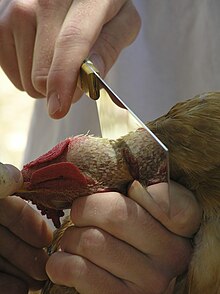
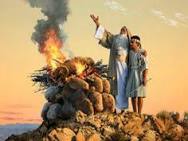
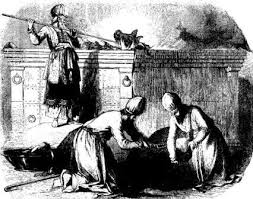
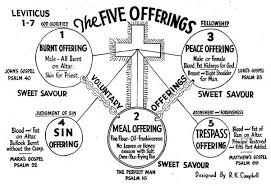
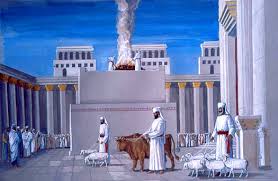
 ). This term does not mean literally "burnt offering," but "what is brought up" or presented to the Deity. The name is a translation of the Septuagint rendering, which is itself based upon the descriptive phrase often attached to "'olah" in the ritual prescriptions: "an offering made by fire unto the Lord" (Lev. i. 9 et seq.). A synonym is
 , which defines the offering as complete; i.e., when it is placed upon the altar, to distinguish it from the other forms of animal sacrifice (see I Sam. vii. 9; compare Ps. li. 21). The burnt offering was the highest order of sacrifice in the Old Testament ritual. The bloodless offerings were made only in connection with it.