ஜப்பான் அமெரிக்க பாண்டுகளை விற்கத் தொடங்கியது: டாலர் மதிப்பில் என்ன தாக்கம்? 

2025 ஏப்ரல் மாதம், ஜப்பான் அமெரிக்க அரசு பாண்டுகளை (US Treasury Bonds) பெருமளவில் விற்கத் தொடங்கியது. இது டிரம்ப் தலைமையிலான அமெரிக்காவின் புதிய வர்த்தகக் கட்டுப்பாடுகளுக்கு (tariffs) பதிலாக நடந்தது. ஜப்பானின் இந்த நடவடிக்கை, உலகளாவிய நிதி சந்தைகளில் பெரும் பரபரப்பை ஏற்படுத்தியுள்ளது. ஏனெனில், ஜப்பான் அமெரிக்காவின் மிகப்பெரிய பொருளாதார துணையாக இருந்தாலும், இது அமெரிக்க டாலரின் ஆஞ்சிய நிலையை சவாலுக்கு உட்படுத்துகிறது. இந்தக் கட்டுரை, இந்தச் சம்பவத்தின் பின்னணி, காரணங்கள் மற்றும் டாலர் மீதான தாக்கத்தை ஆழமாகப் பார்க்கிறது.
சம்பவத்தின் பின்னணி
ஜப்பான், உலகின் மிகப்பெரிய US Treasury பாண்டுகளின் உரிமையாளர்களில் ஒன்று. 2022 ஜனவரி முதல் 2025 ஜனவரி வரை, ஜப்பானின் பாண்டு நிலையம் $1.29 டிரில்லியனிலிருந்து $1.07 டிரில்லியனாகக் குறைந்தது – அதாவது $220 பில்லியன் அளவு விற்பனை. இதன் தொடக்கமாக, 2025 ஏப்ரல் முதல் இரு வாரங்களில் மட்டும் $20 பில்லியன் மதிப்புள்ள பாண்டுகள் விற்கப்பட்டன: ஏப்ரல் 4 வரை $17.5 பில்லியன், அதன் பிறகு $3.6 பில்லியன்.
இந்த விற்பனை, டிரம்பின் ஏப்ரல் 2 அன்று அறிவித்த வர்த்தகக் கட்டுப்பாடுகளுக்கு (ஜப்பான் பொருட்களுக்கு 25% வரி) பதிலாக வந்தது. ஜப்பான் நிதி அமைச்சகத்தின் தரவுகள் இதை உறுதிப்படுத்துகின்றன. இது ஜப்பானின் "பொருளாதார ஆயுதம்" போன்ற நடவடிக்கையாகக் கருதப்படுகிறது, 1985 பிளாசா உடன்படிக்கையை நினைவூட்டுகிறது.
ஜப்பானின் காரணங்கள்: யன் வலுப்படுத்தல் மற்றும் பன்முகமயமாக்கல்
ஜப்பான் இந்த விற்பனையைத் தொடங்கிய காரணங்கள் பல:
- வர்த்தக மோதல்: டிரம்பின் வரி அறிவிப்பு, ஜப்பானின் ஏற்றுமதியை பாதிக்கும். இதற்கு பதிலாக, ஜப்பான் தனது $1.1 டிரில்லியன் US பாண்டு நிலையத்தை "பேரம்" ஆகப் பயன்படுத்துகிறது.
- உள்நாட்டு நிதி கொள்கை: ஜப்பான் வங்கி (BOJ) வட்டி விகிதங்களை உயர்த்தி, யன் மதிப்பை வலுப்படுத்த முயல்கிறது. இதற்காக வெளிநாட்டு முதலீடுகளை உள்நாட்டு பாண்டுகளுக்கு மாற்றுகிறது. 2025 பிப்ரவரியில், ஜப்பான் ஐரோப்பிய பாண்டுகளில் 1.68 டிரில்லியன் யன் ($12 பில்லியன்) முதலீடு செய்தது – ஜெர்மன் ($542.5 பில்லியன் யன்) மற்றும் பிரெஞ்ச் ($621.6 பில்லியன் யன்) பாண்டுகள் முக்கியம்.
- பன்முகமயமாக்கல்: ஜப்பான் ASEAN நாடுகளுடன் யன் அடிப்படையிலான குடிமை அமைப்புகளை ஆராய்கிறது. மேலும், தங்கம், ஐரோப்பிய கரன்சி, டிஜிட்டல் சொத்துக்கள் போன்றவற்றில் முதலீடு அதிகரிக்கிறது.
இது ஜப்பானின் உள்நாட்டு முதலீட்டாளர்களை ஈர்க்கிறது: 2025 மார்ச் மாதம், 10 ஆண்டுகளுக்கு மேற்பட்ட JGBகளில் $15 பில்லியன் முதலீடு – 2004-ஆம் ஆண்டு முதல் அதிகபட்சம்.
டாலர் மதிப்பில் தாக்கம்: அழுத்தம் மற்றும் ஏற்ற இறக்கம்
ஜப்பானின் விற்பனை, டாலரின் மதிப்பை நேரடியாக பாதிக்கிறது. US Treasuries-இன் சந்தையில் அதிக விநியோகம் (supply) ஏற்படுவதால்:
- பாண்டு விலை குறைவு, வட்டி விகித உயர்வு: 10-ஆண்டு US பாண்டு வட்டி விகிதம் 4.592% வரை உயர்ந்தது – 2001-க்குப் பிறகு அதிகபட்ச வார உயர்வு. 30-ஆண்டு விகிதம் 5% வரை சென்றது. இது அமெரிக்க அரசின் கடன் செலவை அதிகரிக்கிறது.
- டாலர் பலவீனம்: விற்பனைக்குப் பிறகு டாலர் யன் மற்றும் ஐரோப்பிய கரன்சிகளுக்கு எதிராக வீழ்ச்சி அடைந்தது. ING FX நிபுணர் ஃபிரான்செஸ்கோ பெசோலே கூறுகையில், "அமெரிக்காவை விற்கும் (sell America) சூழல் உண்மையாகிறது; இது டாலருக்கு நச்சுத்தன்மையானது." யன் டாலருக்கு எதிராக உயர்ந்தது, ஏனெனில் ஜப்பான் முதலீட்டாளர்கள் உள்நாட்டு சொத்துகளுக்கு திரும்புகின்றனர்.
- உலகளாவிய தாக்கம்: டாலரின் பங்கு உலக ரிசர்வ் கரன்சியில் 58% ஆகக் குறைந்துள்ளது – காலாண்டுகளுக்கு முந்தைய குறைந்தபட்சம். ஐரோப்பிய பாண்டுகள் (ஜெர்மன் bunds) பாதுகாப்பு சொத்துகளாக மாறுகின்றன. இது அமெரிக்காவின் கடன் திறனை சவாலுக்கு உட்படுத்தி, பணவீக்கத்தை அதிகரிக்கலாம்.
ஆனால், Moody’s விமல்குணர் ஸ்டெஃபன் ஆங்க்ரிக் கூறுகையில், "$20 பில்லியன் விற்பனை, சந்தை அளவில் சிறியது; தாக்கம் குறைவு." முன்னாள் BOJ அதிகாரி சாயுரி ஷிராய், "டாலருக்கு மாற்று இல்லை" என்று கூறி, ஜப்பான் விற்பனையை தாமதப்படுத்தியதாகத் தெரிவித்தார்.
எதிர்கால விளைவுகள்
இந்த விற்பனை, டிரம்பின் வர்த்தகப் போரை தீவிரப்படுத்தலாம். சீனா, UK போன்ற நாடுகளும் US பாண்டுகளை விற்கத் தொடங்கினால், டாலர் மேலும் பலவீனமடையும். ஜப்பான், யன்-அடிப்படை அமைப்புகளை வலுப்படுத்தி, பல-மைய (multi-polar) உலகப் பொருளாதாரத்தை ஊக்குவிக்கிறது. முதலீட்டாளர்கள், தங்கம் அல்லது ஐரோப்பிய சொத்துகளை பரிந்துரைக்கின்றனர்.
முடிவுரை
ஜப்பானின் US பாண்டு விற்பனை, டாலரின் ஆஞ்சிய நிலையை சவாலுக்கு உட்படுத்தி, அமெரிக்க நிதியை நெருக்கடிக்கு தள்ளுகிறது. டாலர் வீழ்ச்சி, உலக வர்த்தகத்தை மாற்றும். ஆனால், டாலரின் ஆதிக்கம் இன்னும் நீடிக்கும் என்பது உறுதி. இந்த நிலைமையை கவனித்து, முதலீட்டாளர்கள் எச்சரிக்கையுடன் இருக்க வேண்டும். மேலும் விவரங்களுக்கு, Financial Times அல்லது Reuters போன்ற தளங்களைப் பார்க்கவும்.
JAPAN JUST KILLED THE GLOBAL MONEY PRINTER AND NOBODY NOTICED
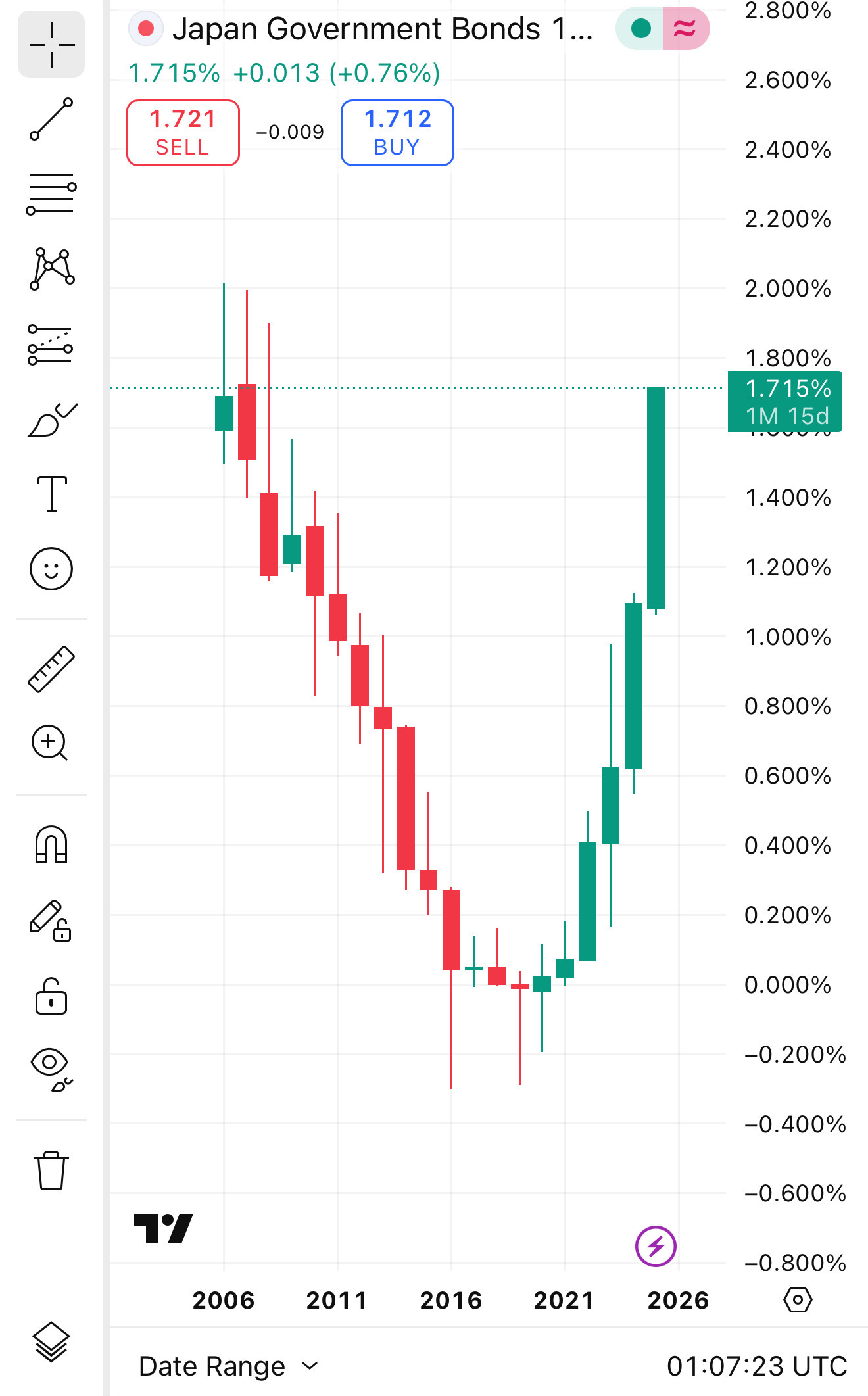
https://substack.com/inbox/post/179099797?r=6p7b5o The most dangerous number in finance right now is 1.71%. That’s Japan’s 10-year bond yield. Highest since 2008. Here’s why your retirement just got obliterated: For 30 years, Japan printed infinity money at 0% rates and exported it worldwide. $3.4 trillion flowed into US Treasuries, European debt, emerging markets. This invisible bid kept YOUR mortgage cheap, YOUR stocks inflated, YOUR government solvent. November 10th, 2025: The bid disappeared. Japan’s yield hit 1.71%. They’re pumping $110 billion stimulus into their economy while debt sits at 263% of GDP. The math just became impossible. At 1.7% rates, Japan pays $27 billion MORE in interest. Every. Single. Year. Here’s the extinction event nobody sees coming: Japanese pension funds are pulling $1.1 trillion OUT of US Treasuries right now because keeping money in America LOSES them money after hedging costs. The largest foreign buyer of American debt is becoming a seller. When Japan stops buying, interest rates don’t stay flat. They explode. US 10-year yields will jump 40 basis points minimum from flow dynamics alone. Your 7% mortgage becomes 8%. Corporate debt refinancing costs spike 60%. Zombie companies holding $3 trillion in junk bonds start defaulting in waves. The yen carry trade just reversed. $1.2 trillion in borrowed yen funding crypto, stocks, emerging markets must unwind. Every hedge fund, every momentum trade, every leveraged bet built on free Japanese money is getting margin called simultaneously. This breaks in three places: Stock valuations were built for 2% bond yields forever. At 3.5% yields, the S&P 500 fair value drops 35%. Emerging market currencies collapse without Japanese capital inflows. Europe’s debt crisis returns because Italy and Spain lose their silent buyer. December 18th the Bank of Japan meets. 50% chance they hike again. If they do, sell everything not nailed down. Your 401k doesn’t price this in yet. The Fed can’t stop this. No central bank can. The world’s biggest piggy bank just cracked open and the money is flowing backwards. Position accordingly or get destroyed.When the world’s largest creditor stops subsidizing everyone else’s debt, the entire architecture of global finance must be rebuilt. That moment arrived on November 10, 2025.
By Shanaka Anslem Perera
On a seemingly ordinary Monday in November, Japan’s 10-year government bond yield touched 1.71 percent. For most observers, this was a technical footnote buried in the daily market data. For those who understand the intricate plumbing of global finance, it was the sound of the Jenga tower’s critical block sliding free.
That 1.71 percent figure represents the highest yield on Japanese government bonds since June 2008, when Lehman Brothers still existed and the global financial system stood weeks away from systemic collapse. But unlike 2008, when external crisis drove yields higher, this move originates from deliberate policy choices within Japan itself. The implications are far more profound than any single market dislocation.
What happened on November 10th was not merely a bond market adjustment. It was the beginning of the end of a three-decade arrangement that quietly underpinned the entire post-Cold War financial order. Japan, the world’s largest net creditor nation with over $3 trillion in net foreign assets, has begun the long process of bringing that capital home.
The Architecture of Suppression
To understand why this matters, we must first grasp what Japan has been doing for the global financial system since the early 1990s.
Following the collapse of its asset bubble in 1991, Japan entered a deflationary spiral that would last three decades. The Bank of Japan drove interest rates to zero by 1999 and kept them there, eventually pushing into negative territory in 2016. Yield curve control, implemented in 2016, pegged the 10-year JGB yield near zero percent through massive bond purchases.
This created a structural problem for Japanese institutional investors. Insurance companies managing long-dated liabilities, pension funds facing demographic decline, and banks awash in deposits all faced the same dilemma: domestic assets yielded nothing, but their obligations were real and growing.
The solution was simple and world-altering. Japanese capital flooded outward. By 2024, Japan held $1.13 trillion in US Treasury securities, making it the largest foreign holder of American government debt alongside China. European bonds, agency securities, corporate credit, and emerging market debt all absorbed massive Japanese flows.
This was not charity. It was rational portfolio construction. But it had profound systemic effects. Japanese buying provided a persistent bid under global bond markets, suppressing term premiums and keeping borrowing costs artificially low across the developed world. The presence of this patient, yield-hungry capital allowed the United States to run persistent fiscal deficits, Europe to maintain its currency union despite structural imbalances, and emerging markets to access hard currency funding at historically low costs.
For three decades, Japan’s deflation exported disinflation to the rest of the world. Japanese savers, unable to earn returns at home, effectively subsidized borrowers everywhere else.
The Inversion
November 10th marked the moment this arrangement began to unwind in earnest.
The immediate catalyst was threefold. First, the Bank of Japan has been gradually normalizing policy after ending negative interest rates in March 2024 and raising its policy rate to 0.5 percent. Second, the Japanese government announced plans for a fiscal stimulus package exceeding ¥17 trillion (approximately $110 billion), aimed at combating residual deflation risks and boosting strategic sectors including semiconductors and artificial intelligence. Third, and most critically, market expectations shifted toward the possibility of further Bank of Japan rate increases, with futures markets pricing roughly 50 percent probability of another hike at the December 18th policy meeting.
These three forces converged to push JGB yields sharply higher. But the real story lies in what happens next.
At 1.71 percent, the mathematics of Japanese institutional investment have fundamentally changed. Consider the position of a Japanese life insurance company managing yen-denominated liabilities. To invest in US Treasuries, this institution must hedge the foreign exchange risk. That hedging cost, determined by the interest rate differential between Japan and the United States, has now risen to the point where hedged yields on US Treasuries frequently turn negative.
In plain terms: it now costs Japanese institutions money to own American government debt on a hedged basis.
This is not a temporary arbitrage dislocations. It is a structural shift in the risk-return calculus that has governed Japanese capital allocation for a generation. Every additional basis point that JGB yields rise makes foreign bonds less attractive and domestic assets more competitive.
The logical consequence is already beginning to manifest. Japanese investors are reducing foreign bond holdings and repatriating capital. This process will not happen overnight—institutional portfolios turn slowly—but the direction is clear and the momentum is building.
The Cascade
When a creditor the size of Japan begins withdrawing from global debt markets, the effects cascade through multiple channels simultaneously.
First, term premiums must rise. The term premium is the extra yield investors demand for holding longer-dated bonds rather than rolling over short-term securities. For years, Japanese buying compressed term premiums across developed markets. As that bid recedes, term premiums must rise to attract alternative buyers. Estimates vary, but a sustained withdrawal of Japanese capital could mechanically add 20 to 50 basis points to long-term yields in the United States and Europe over the next several years, independent of central bank policy rates or inflation expectations.
This matters immensely. It means that even if the Federal Reserve succeeds in bringing inflation to target and cutting short-term rates, long-term borrowing costs may not decline as much as markets expect. The 30-year mortgage rate, corporate bond yields, and government financing costs all face structural upward pressure from the simple absence of Japanese demand.
Second, the yen carry trade enters a new regime. For two decades, the yen has been the world’s premier funding currency. Hedge funds, banks, and institutional investors borrowed in yen at near-zero rates to purchase higher-yielding assets elsewhere: emerging market bonds, high-yield credit, dividend-paying equities, even cryptocurrencies. This “carry trade” has been one of the most persistent and profitable strategies in global macro investing.
As Japanese rates normalize, the economics of this trade deteriorate rapidly. The funding cost rises while the volatility of the yen—which tends to appreciate sharply during risk-off episodes—increases. Historical precedent from the yen spike in August 2024, when the currency appreciated 13 percent in weeks following a surprise Bank of Japan hike, demonstrates the violence with which these trades can unwind.
The outstanding notional value of yen-funded carry positions is difficult to measure precisely but conservatively estimated in the range of $1 trillion or more. Even a partial unwinding would force selling across risk assets, particularly in emerging markets and sectors dependent on leveraged flows.
Third, fiscal arithmetic changes globally. Japan’s public debt stands at approximately 263 percent of GDP, the highest ratio among major developed economies. This debt burden has been sustainable because the effective interest rate paid on that debt has been close to zero. As yields normalize, interest expense rises dramatically.
At current debt levels, a 100-basis-point increase in the average funding cost adds roughly ¥3 trillion to annual interest payments, equivalent to about 0.5 percent of GDP. The proposed ¥17 trillion stimulus package must now be financed at materially higher rates than any stimulus over the past fifteen years. This changes the fiscal multiplier calculus and raises legitimate questions about medium-term debt sustainability.
If Japan—the most fiscally stretched major economy—begins to face binding constraints from higher interest costs, the signal to other heavily indebted governments is clear. The era of “deficits don’t matter” is ending. Fiscal space is no longer infinite when creditors demand positive real returns.
The Geopolitical Dimension
Beyond market mechanics, Japan’s pivot has profound geopolitical implications that have barely entered public discourse.
The post-1945 economic order was built on American hegemony, enforced partly through the dollar’s reserve currency status and the depth of US capital markets. A critical component of this system has been the willingness of allied creditor nations—Japan, Germany, oil exporters—to recycle their surpluses into dollar assets, particularly Treasuries.
Japan’s role in this recycling has been both enormous and reliable. Through decades of current account surpluses, Japan accumulated claims on the rest of the world and consistently chose to hold a large portion in dollar-denominated assets. This was partly economic rationality and partly strategic alignment—supporting the US fiscal position served broader alliance interests during the Cold War and after.
That bargain is now under pressure from purely domestic forces. Japan’s aging society needs higher returns to fund pensions and healthcare. The political economy of Japan increasingly prioritizes domestic stability over external commitments. And crucially, the emergence of China as a rival center of economic gravity creates alternative pathways for Japanese capital and trade.
The United States has grown accustomed to financing large fiscal deficits—now running around 6 percent of GDP—at relatively low rates despite mounting debt. The Congressional Budget Office projects US federal debt held by the public will reach 122 percent of GDP by 2034 under current law. These projections implicitly assume continued access to cheap foreign capital.
If the largest foreign buyer becomes a net seller, even gradually, the financing burden shifts to domestic investors and price-sensitive foreign capital. The result is higher real interest rates, slower growth, or some combination thereof. This is not crisis language—it is arithmetic.
The Deflationary Endgame
There is a deeper, more philosophical dimension to what is unfolding. Japan’s thirty-year deflation was not merely an economic phenomenon. It was a social and psychological condition—a collective loss of faith in the future that manifested as excess saving, risk aversion, and demographic decline.
By exporting capital at zero return, Japan was essentially exporting the psychology of deflation. Global asset prices inflated not because of fundamentally strong growth prospects but because vast pools of capital had nowhere else to go. Negative real yields became normalized. Risk premiums compressed to historic lows. Investors reached desperately for any positive return, no matter how fragile the underlying asset.
This dynamic inflated equity valuations, suppressed volatility, and encouraged speculation. It created what economist Hyman Minsky called “Ponzi finance”—asset values dependent on ever-increasing leverage and perpetually low rates rather than cash flows or fundamentals.
Japan’s yield normalization signals the potential end of this cycle. If deflation psychology is truly breaking in Japan—if inflation expectations are finally rising and domestic demand is recovering—then the capital that once fled seeking yield will find opportunities at home. The global deflationary impulse reverses.
But here lies the trap. The rest of the world has built economic structures dependent on that deflationary impulse. Corporate leverage, government debt, and household balance sheets all assume perpetually low rates. Asset valuations embed the assumption that “there is no alternative” to risk assets.
When Japan brings its capital home, the rest of the world must confront a question avoided for three decades: What is the equilibrium real interest rate in a world without Japanese deflation subsidies?
The answer is almost certainly higher—perhaps much higher—than current market pricing.
Three Paths Forward
Markets and policymakers now face three broad scenarios over the next three to five years.
Scenario One: Orderly Repricing. JGB yields stabilize in the 1.5 to 2.0 percent range. The Bank of Japan raises rates gradually to around 1.0 percent but pauses if growth weakens. Japanese repatriation proceeds slowly, adding 20 to 30 basis points to global term premiums over several years. Asset repricing is painful but manageable. Equity multiples compress modestly. Credit spreads widen but defaults remain contained. This is the consensus scenario, carrying perhaps 50 percent probability.
Scenario Two: Japanese Reflation Success. The fiscal stimulus works. Nominal GDP growth accelerates. Wages finally rise in a sustained fashion. Japan experiences a genuine economic revival after three lost decades. JGB yields move toward 2.5 percent but debt sustainability improves because nominal growth keeps pace. Japanese equities outperform global peers. The Nikkei becomes an engine of growth rather than a value trap. This upside scenario, perhaps 20 percent probable, would be celebrated in Tokyo but would require significant repricing globally as Japanese capital increasingly stays home.
Scenario Three: Debt Trap Triggered. Yields overshoot, rising above 2.5 percent into a global risk-off environment. Japan’s interest burden becomes unsustainable given its debt stock. The Bank of Japan is forced into a humiliating reversal—reimposing yield curve control or restarting large-scale quantitative easing despite inflation above target. The policy reversal destroys central bank credibility and triggers sharp yen depreciation. Japanese institutions panic-sell foreign assets to cover domestic losses. Global bond markets experience acute dislocations. This tail risk scenario, perhaps 15 percent probable, would test the limits of policy coordination.
The remaining probability mass sits in various hybrid and intermediate outcomes, but these three scenarios capture the essential uncertainty.
Investment and Policy Implications
For investors, the strategic implications are clear even if the tactical timing remains uncertain.
Duration risk has returned. The 40-year bull market in bonds, driven by declining inflation and central bank suppression of yields, is over. Long-dated fixed income now carries real risk of capital loss, not merely opportunity cost.
The Japanese yen will become a key barometer of global financial stress. In a reversal of the past two decades, yen volatility will rise and sharp appreciations during risk-off episodes will become more frequent and severe as carry positions unwind.
Equity valuations must adjust to a regime of structurally higher discount rates. The sectors most vulnerable are those with distant, uncertain cash flows priced for perpetually low rates: unprofitable technology, long-duration growth, and speculative early-stage ventures.
Conversely, Japanese domestic equities—particularly financials, which benefit from positive yield curves and higher net interest margins—may finally offer attractive risk-adjusted returns after decades of disappointment.
For policymakers, the task is more complex. Central banks in the United States and Europe have limited tools to offset structural rises in term premiums driven by foreign capital flows. Fiscal authorities face a world where deficit financing becomes genuinely expensive, forcing difficult choices between spending priorities and debt sustainability.
The political economy of this adjustment will be fraught. Publics in the West have grown accustomed to cheap money financing public services and asset wealth. The withdrawal of Japanese subsidies will feel like an external imposition, even though it results from rational Japanese choices.
Conclusion: The Price of Capital
What is unfolding is not a crisis in the traditional sense—no banks are failing, no currencies are collapsing, no markets are freezing. Instead, we are witnessing something more subtle and more profound: the slow-motion repricing of capital itself.
For three decades, the global economy has operated in a regime where the price of money was distorted by Japanese deflation. Capital was abundant and cheap because Japanese savers, trapped in a deflationary psychology, exported their savings at minimal return.
That distortion is now unwinding. The world is being forced to discover the true price of capital—the rate at which savers voluntarily defer consumption and accept risk. That price is higher than we have grown accustomed to.
This is not the end of the world. It is the end of a very particular world—one characterized by negative real rates, compressed risk premiums, and the assumption that central banks could perpetually suppress volatility.
The new regime will be more volatile, more expensive, and more discriminating. Asset prices will be determined more by cash flows and less by liquidity. Leverage will carry real cost. Speculation will face genuine consequences.
For those positioned correctly, this transition creates enormous opportunities. For those clinging to the old regime’s assumptions, it will be devastating.
Japan’s message to the world is simple: we are no longer willing to subsidize your debt at zero return. You must now stand on your own.
The rest of the world is only beginning to understand what that means.

No comments:
Post a Comment